
Why Self-Supported Racing Works and How it Improves Trail Running Quality

At CapitalTrails, we’ve been pioneering unsupported and self-supported trail running (and outdoor experiences) since we started seven years ago in 2019. All our group meets, FKTs, community efforts, and races, follow the ethos of self-sufficiency, and aim at imparting basic outdoor skills to our participants. At the same time, it also reinforces our role as responsible practitioners of outdoor adventure activities.
The second edition of Sohna By CapitalTrails - also our 12th race overall - concluded last weekend. We saw some fast photo-finishes in the 10k and 25k categories, with the podiums separated by under 30 seconds and 2 minutes respectively. On the other hand, the flagship 50k saw 7 finishes - 5 for the first time and 2 for the second time - in a format that’s 100% self-supported with no aid stations or route markings along the way.
As we work further towards pushing the boundaries of trail racing in India, here’s a reflection on why self-supported racing works and how it improves the overall quality of trail running.
Smaller Footprint, Stronger Organisers
When we put together our first race in Asola back in 2023, the mantra was ‘eliminate, eliminate, eliminate’. Twelve races later, the mantra hasn’t changed - no route markings, no aid stations, no ribbons left fluttering on kikar trees weeks after the race. What remains is a GPX file, a handful of volunteers at bare-minimal checkpoints, a timing system, and safety.

But here’s the part that often gets missed - a minimal footprint on the trail doesn’t mean minimal effort behind it. If anything, stripping everything away forces us to get much better at the few things we do keep.
First aid, everywhere. With fewer volunteers spread across a course with no aid stations, every person on the ground has to be able to handle an emergency on their own. There’s no medical tent two kilometres away to pass the problem on to. This has pushed us to get more and more of our crew and community members first aid qualified - and that’s a skill that stays with them (and with the community) long after race day.
Timing that holds up. When runners self-time at checkpoints and podiums are decided by under 30 seconds (as we saw in the 10k at Sohna), there’s simply no room for sloppy timing. Every scan, every checkpoint, every cut-off has to be precise - and verifiable. Self-timing doesn’t make timing any less important. It makes it everything.
Knowing the trail inside out. No markings means we can’t rely on ribbons to do the talking. We need to know every junction where runners are likely to go wrong, every bail-out point, every stretch with no network, and how the terrain changes with the season. That knowledge goes into the route, the briefing and our safety plan - and it makes us better stewards of these trails in general.
Volunteering at its finest. CapitalTrails events are only possible because of the race crew - community members who give up their weekends to recce routes, manage checkpoints in the middle of the forest, handle timing and stay on standby for safety, often while their friends are out racing. A lean format means there’s no hiding behind numbers: every volunteer has a real role, and every role matters. In many ways, a self-supported race asks as much self-sufficiency of its crew as it does of its runners - and our crew delivers, every single time.
Simply put, the less we put on the trail, the more we have to put into it.
Fewer Stops, Faster Finishes
This one sounds counter-intuitive at first. No aid stations should mean slower runners, right?
Not quite.
Anyone who has run a supported race knows the aid station trap. You walk in, grab a cup of electrolytes, eat a banana and a handful of chips, chat with the volunteers, refill your bottles, pose for a picture - and before you know it, 5-7 minutes have gone by. Multiply that by 4 or 5 aid stations in a 50k and you’ve spent close to half an hour standing still.

In a self-supported race, on the other hand, there’s no table to stop at. Everything you need is on you, and you eat and drink on the move. The clock doesn’t wait, and neither do you. Runners settle into a rhythm early and hold it - fuelling in small, regular doses rather than in large, irregular binges at the next table.
In our experience, the gap between moving time and elapsed time is far narrower in our races than in conventional ones. And the photo-finishes at Sohna - under 30 seconds in the 10k and under 2 minutes in the 25k - are as much a result of runners (almost) never stopping as they are of how evenly matched they were.
Better Planning, Smarter Runners
If there’s one skill that a self-supported race teaches better than anything else, it’s planning - and it starts with the mandatory gear list.
As we laid out in the pre-race briefing, every runner at Sohna had to carry a baseline that scaled with the distance. On top of that, the essentials - a whistle, a battery pack, and the rest of the safety kit - were non-negotiable across categories.
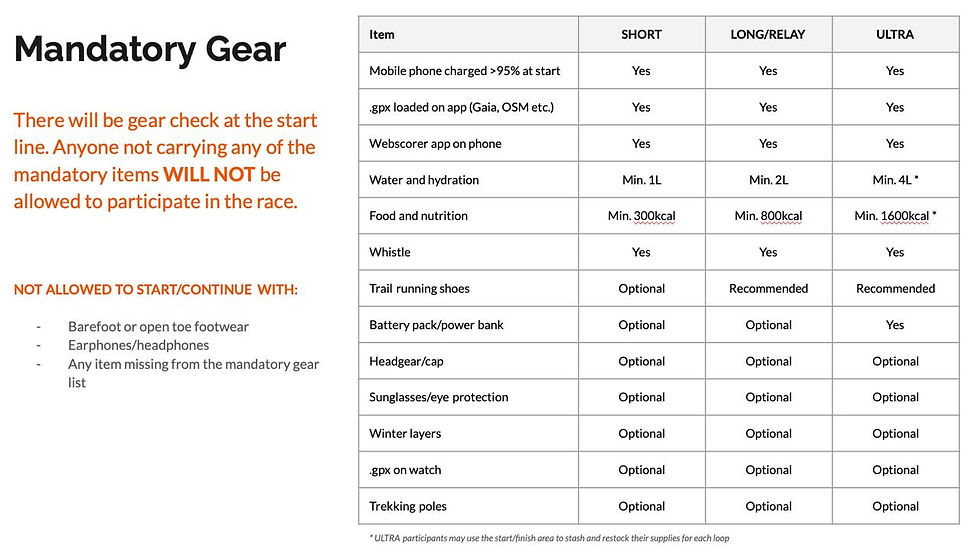
The mandatory list is the floor, not the ceiling. It takes the guesswork out of the bare minimum, and then hands every runner the real question: what do I need over and above this? Do I run hot and need more water? Do I prefer real food over gels? What’s on me, and what goes in the stash?
These are the very questions a fully-supported race lets you skip. And skipping them is exactly how most runners end up under-prepared the day they step into a mountain race, or a remote trail where the next aid station is hours away.
The by-product? Runners who know exactly what their body needs over a given distance and terrain, and who carry that knowledge (quite literally) into every race after. That’s a skill no aid station can hand out.
Solving Problems Together, Competing Better
Getting lost in a race without route markings is a feature, not a bug. Everyone gets lost - the fastest runner, the first-timer, the veteran - and nobody’s immune. As we noted after our very first race, the finish line can sometimes feel like a contest between who got lost more rather than who finished first.
And that’s where something special happens. A missed turn stops being one runner’s problem and becomes a shared puzzle. Two or three runners who were racing each other a few minutes ago end up huddled over their watches at a junction, reading the GPX, debating which dirt track is the right one, and agreeing on a way forward. One spots the line on the map, another remembers a landmark from the briefing, a third checks the distance - and together, they’re back on course.
None of this takes away from the racing. The moment the problem is solved, the competition is back on (the podium gaps at Sohna are proof enough). But it plays out between people who’ve just figured something out together - with a lot more respect, and a lot less ego.

It’s a kinship you rarely see at bigger races, where you’re one among hundreds following ribbons to the next table. In a self-supported race, the only ‘support’ you have out there is the runner next to you - and more often than not, two heads really are better than one.
More Pride, More Honest Self-Evaluation
Finishing a race is always a proud moment. Finishing one where you carried everything, found your own way and timed yourself is a different kind of proud.
There’s no one to thank for the bananas or the ribbons on the trees. Every decision on the course - when to eat, which turn to take, when to push and when to hold back - was yours, and so is the finish. In two editions, we've had 10 people in all who have completed the 50k course fully self-supported. We've had folks who wanted Sohna to be their first ultramarathon. We saw 5 folks crossing that line for the very first time, and 2 crossing it for the second. To us, that was the real headline of the weekend.
The format also forces an honest self-evaluation. In a supported race, it’s easy to blame the aid station that ran out of water or the marking that pointed the wrong way. In a self-supported race, there’s nothing (and no one) to hide behind. You know exactly where you lost time, where you went off-route, what you under-packed and what you didn’t need at all. That kind of feedback is what makes a runner better - not just at the next race, but out on the trails in general.
And as with FKTs, an honest effort makes for the best bragging rights.

Looking Ahead - Why We'll Keep Racing Self-Supported
Is self-supported racing for everyone? Probably not - and that’s okay. Will it replace the big, fully-supported races in India? Unlikely, and it doesn’t need to.
What it does is fill a gap we’ve felt since day one: a format that puts a runner’s own skills - navigation, planning, fuelling, decision-making - at the centre of the race, while leaving the lightest possible mark on the trails we all love running on. Faster finishes, better-prepared runners, healthier competition and a deeper sense of achievement are simply what follow.
Twelve races in, we’re more convinced than ever that this is how trail running in India should grow - one self-sufficient runner at a time.
See you on the trails. Bring water!


Comments