
Race Report - Through the Fog: Finding Myself at Sohna 50K

After Indrahar summit run, the next race I wanted to do was CapitalTrails Race Series - Sohna 50k. I had planned properly the training but got sick and my weekly mileage kept decreasing week after week. I wanted to quit even before starting the race training.
The decision to run 50 kilometres is never made lightly. For me, it was a promise I made to myself on November 26th - the day my health returned after weeks of being sidelined by illness. The Delhi NCR pollution had ravaged my training cycle, each week bringing lower mileage than the last. The easier path whispered seductively: choose the 25K instead. But I had reasons deeper than statistics.
I needed to return to ultra distances before the year ended. More importantly, I wanted to experience what self-supported racing truly meant - carrying my own water, managing my own fuel, navigating my own way through the wilderness. No other race format could offer both. So, I said yes to the 50K, yes to the uncertainty, yes to whatever Sohna would throw at me.

The Night Before: Preparation Meets Doubt
The ride to the starting point on December 20th felt like traveling through layers of reality. As I got closer to the race starting point, just 50 kilometres away from the Delhi I'd been gasping through all season, the air changed. The fog rolled in thick and strange, transforming the landscape into something otherworldly. When I stepped down of the bike, I felt it immediately - despite being near the city, the air here was cleaner, easier to breathe. The pollution that had haunted my training vanished somewhere back on the highway.
Sleep came easily that night. The carb-loading was perfect. But the nagging voice in my head kept reminding me: the long runs weren't there. The training hadn't been adequate. I'd made rookie mistakes in my previous races - solid food that my stomach rejected during the humidity of Asola, leaving salt capsules that led to devastating cramps on Indrahar's high altitude slopes. This time, I was determined to get the small things right.
My fueling plan was crisp and clear. Every 30 minutes: a gel. Every 45 minutes: a salt capsule. Every hour: a banana. Water on demand. No improvisation. No guessing.

Race Morning: The Fog Decides Everything
The fog was still there when I woke up. Runners started assembling, race briefing came and went. Then 7:00 AM arrived, and we were off.
The GPS loaded cleanly into my watch and phone. I was on the trails almost immediately, surrounded by a white curtain that limited visibility to maybe fifty meters. Narendran led the 50K field. Andrew was running the 25K. Vikas was somewhere behind them, and I was settling into my position. I agreed on starting slow - even pacing, easy efforts on the hills, a planned 5:30 hours finish time if everything went to plan.
Around 4K, Jamie - smooth, effortless, almost floating over the terrain - caught and passed me. "I'm just figuring out this navigation thing," he joked as he glided by. I was smiling. This was the spirit that brought people to these trails.
By 6K, the fog decided to play tricks on all of us, especially on me.

The Battle with Myself
Around the 7K mark, I made a wrong turn. Found it within 20 meters, corrected course. But then another wrong turn in the fog, this time while trying to return. The disorientation was complete. Looking around through the mist, I saw another figure - Vikas, also fighting with the same confusion. We found the right trail together.
Then I realized something that would define the next 5 kilometres: I'd forgotten to start recording the activity in the Gaia app. That small thing - that color-coded trail that marks your movement on the phone screen - became my psychological anchor. Without it, I was navigating in pure white. Every few seconds, the doubt crept in. Am I on the right trail? Am I running in the wrong direction? The checking became obsessive.
Stop. Stare at the phone. Reorient the map. Run. Repeat.
The exhaustion wasn't physical. It was mental. Constant self-conviction that I was doing the right thing, even when my body knew the path was correct. By 12K, I finally saw Andrew ahead of me, and the relief was visceral - confirmation that I was where I was supposed to be.
But the trail had one more lesson waiting.
My phone was in my right hand. My eyes were on the screen. My right foot caught a small stone on the trail. The balance was lost. There was a split second where I thought I had it under control, and then - boom. I was lying flat on the dirt.
For a moment, I lay there. Small scratches on my left knee. Hand kada bent cutting slightly the right wrist. Clothes covered in dust. Phone covered in dirt.
And then I laughed.
I'd finally fallen on the trails. After all these races, all this training, it took fog and confusion and a moment of inattention to give me this rite of passage. I became a true trail runner that day - someone who falls and gets back up.

The Forgotten Gel and the First Loop
The pace was staying consistent with my plan. Andrew overtook me again as I settled into my rhythm. The first major mistake happened at the 2:30-hour mark when I skipped the fifth gel. I told myself I'd have it after finishing the loop. I didn't. Not a disaster, but a break in the protocol I'd so carefully constructed.
Coming into the loop finish at 9:40 AM, I'd consumed all my electrolyte water but still had plenty of plain water. The gloves were wet and came off. The upper layer was damp with sweat despite the cold. The fog was beginning to settle. I refilled the soft flask, grabbed four gels (one was already in my bag), restocked my salt capsules, and realized too late that the bananas were in a different pocket of my drop bag.
The second loop loomed ahead. I was strong. I was ready. I would be more careful about getting lost this time.
The Second Loop: Where Everything Aligned
The pace on the second loop shocked me. At 30K, I realized I was gliding at 5:00 minutes per kilometre. The trail was broad, consistent, beautifully downhill at that point. The nutrition was working. The salt capsules meant no cramping. The gels were delivering exactly what I needed. I was strong because I'd fuelled properly this time.
At 35K, I caught Narendran. We ran together for the next 4 kilometres. Watching him push through the pain of an upset stomach, the way he moved through discomfort with such grace and determination, was inspiring. This was what the ultra-distance teaches you—it's not about who's fastest. It's about who wants it most and can hold themselves together the longest. At 42K, I scanned Kshitish's QR code at the checkpoint (i.e. CP-3) and kept moving.
The Hill That Changed Everything
After 45K came a long, steady hill with loose rocks. My left foot - specifically the toe near the big toe—had been hitting the front of my shoe repeatedly, creating a pain that accumulated with every step. I stopped, tightened the shoe, secured my foot inside. It helped, but not enough to run. I walked that hill.
The emotions hit me as I climbed.
I was going to finish. I was going to do this. Everything that I'd planned for, everything that I'd fought through - the illness, the pollution, the mental battles with fog and doubt, the small mistakes - it was all culminating in the next few kilometres.
I mostly walked the remaining section, with runs when the body allowed me. The second loop was different from the first. The fog had almost entirely lifted now. I could see the trails clearly. The elements that had confused me in the white became clear and specific landmarks in the daylight.
At some point before 1 PM, I crossed the finish line at third place overall.
6 hours and something. I'd done it.

The Numbers Tell One Story; The Mind Tells Another
My pacing strategy had worked. The second loop was proof of what proper nutrition could do. The salt capsules executed perfectly meant I never once felt the cramping that had derailed Indrahar. The navigation, despite the psychological tricks the fog played, had been sound—I'd only made minor detours and corrected them quickly.
But underneath all those tactical wins was one uncomfortable truth: the long run training wasn't there. I'd done what I could with the time I had, but the body knew it was underprepared. What got me across was preparation in other areas - the nutrition plan, the gear strategy, the mental resilience to handle uncertainty.
The water drinking could have been better. I still need to figure out that balance. The gel consumption at loop transitions got sloppy. The bananas never made it into the second loop. These weren't failures - they were datapoints for next time.
But the gear was perfect. The compression socks, the five-finger socks that prevented blisters, the right jacket, the gloves - they all did their job. Details matter in ultras, and the details I could control, I controlled well.

The Unexpected Truth
Standing there after the finish, something shifted inside me.
I realized I have no desire to run road races anymore. There was no specific reason I could articulate, just a deep knowing that this wasn't my medium. I have a New Delhi Marathon already registered - I'll honour that commitment. But after that, I'm done with roads unless some PR needs to be broken.
What I want is this: self-supported trail races where the impact on the environment is minimal, where I carry what I need, where I navigate using my own judgment, where I run on terrain that challenges and rewards in equal measure. The traditional ultra racing circuit feels corporate and disconnected compared to what CapitalTrails has created.
Nakul and Kshitish built something special with this route and this race format. They built a community that values simplicity, challenge, and minimal environmental footprint. That's what CapitalTrails means to me now - not just a race series, but a philosophy of how to pursue this sport.
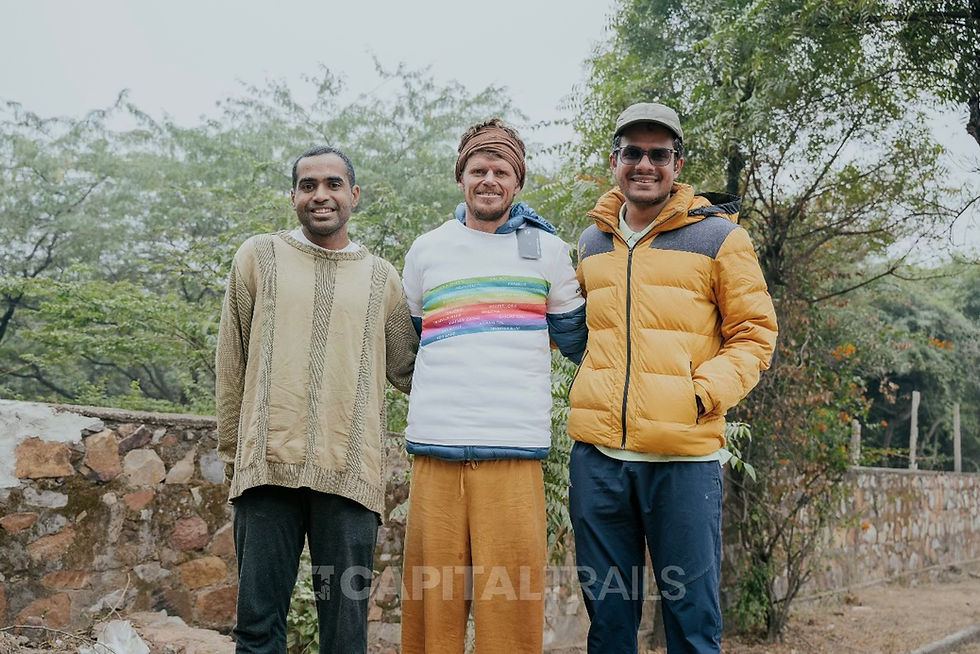
What The Fog Taught Me
As I think back on the race, the fog wasn't an obstacle to overcome. It was a teacher.
It taught me that self-doubt is the only true enemy in ultras. The navigation skills were fine; the panic in my mind was the problem. It taught me that small preparations compound — a salt capsule taken on schedule prevents a crisis later. It taught me that falling and getting back up is part of becoming a trail runner.
The fog revealed that confidence doesn't come from perfect training cycles or ideal conditions. It comes from managing what you can control and accepting what you can't. It comes from having a plan and trusting it even when visibility is zero.
Signing Off 2025
I'm finishing this year differently than I started it. I'm finishing as a trail runner. More specifically, as an ultra-trail runner who knows that self-supported navigation through wilderness is where I'm supposed to be.
The three races - Asola, Indrahar, Sohna - were a progression. Asola taught me about rookie mistakes. Indrahar taught me about altitude and pain management. Sohna taught me about mental resilience when everything is uncertain.
I'm confident in my navigation now. I understand my nutrition needs. I know how to manage self-doubt. I've fallen on trails and gotten back up. I've learned what gear works and what doesn't. I've experienced what it means to be properly supported by a community of runners who share this vision.
2025 is closing with gratitude to Kshitish, Nakul, Chetan and everyone in the CapitalTrails and Summit Run community who made these races possible. You've given me not just events to run, but a lens through which to see myself as an athlete and an adventurer.
2026 is calling, and I'm answering with everything I have.

“The fog at Sohna cleared by noon, but it took longer to clear from my mind. Sometimes the races we run teach us less about our pace and more about what we're capable of enduring. Sometimes the finish line is just the beginning of an understanding”.
This post was voluntarily written and shared by a CapitalTrails member, and all experiences and opinions shared in the race report are the author's own.
Follow Sandeep on Instagram.


Comments