
PANIKOT By CapitalTrails - A Journey Through Thorns and Strength
- Sandeep Yadav
- 19 hours ago
- 4 min read
After Sohna 50k, I promised myself two things: a Tripole hydration bag and no more early morning travel chaos before races. The bag became my trusted companion, and the stay at Saras Damdama lake the night before Panikot turned out to be one of the best decisions I’ve made. This time, I wasn’t holding back. Last year, I had switched from long to short at Panikot, but the unfinished business lingered. On 22 March 2026, I was ready for the long course. My wife stood with me at the start line, and that alone fuelled my determination to finish strong.

The Start – Fog and Confusion
At 6:30 am, the race began under a veil of fog. The air was cool, the energy electric. But CapitalTrails races are never just about speed—they’re about navigation. Within minutes, runners were second-guessing routes, me included. Thankfully, after one wrong turn just before first uphill, I found the designated trail and locked into rhythm. The first 5.5 km to CP-1 felt smooth, my body responding well, my mind sharp. I remembered Kshitish’s (Race Director) briefing about the wall after CP-1. While Andrew and Amit surged straight ahead, I spotted the trail to the right and crossed the wall. That’s when the real adventure began.

Into the Wild Aravallis
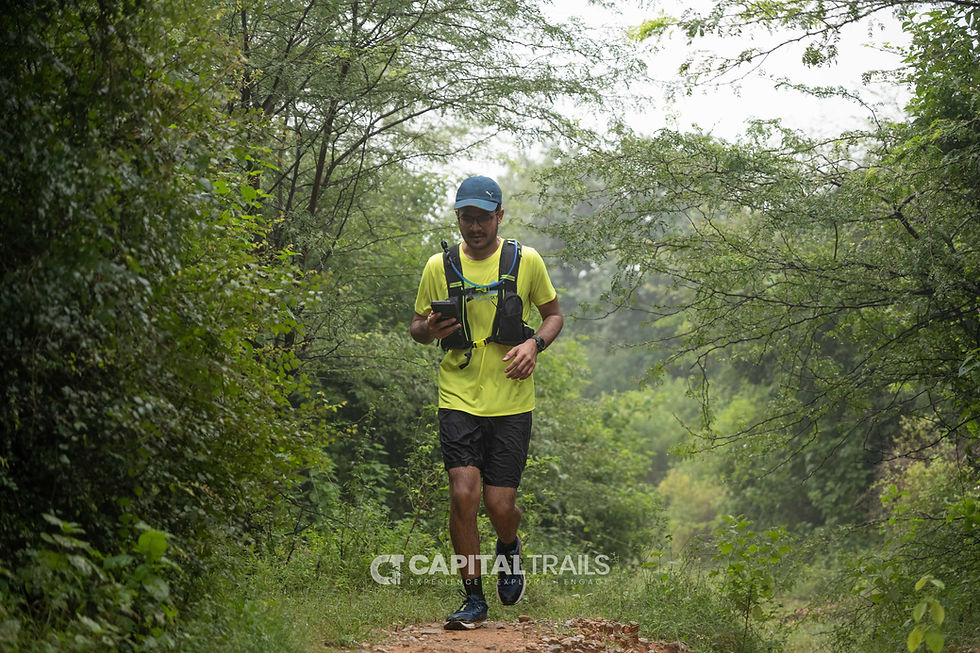
The downhill after CP-1 was pure joy—gravity pulling me into flow. Then came the village stretch, followed by a steep uphill. Soon, the trail turned raw, wild, and unforgiving. Dense Aravalli jungles clawed at us with thorns and bushes, scratching skin like mischievous high-fives. Navigation here was unlike anything I’d experienced in 1.5 years with CapitalTrails. Amit, running alongside me, kept marvelling at the rawness of the trail. The second downhill was steep and littered with loose rocks. I let gravity guide me, careful yet fearless.

Panikot Lakes – Beauty Amid Chaos
Emerging into the Upper Panikot lakes felt surreal. The canyons, the reflections, the sudden burst of beauty—it was a reward for the struggle. At the main Panikot lake, Sang was clicking photos, and the scene was alive with music, bathers, and cheering crowds. CP-2 was buzzing with Akash and Narendran volunteering at this point. But the relief was short-lived—the third and final uphill loomed. Wide trails awaited beyond, and I knew I had given everything till this point. Amit surged ahead, and I found myself alone again, but stronger for it.

The Final Push
A thorn lodged in my foot forced me to stop briefly, just after CP-3 where Chetan and Mehak were stationed. Kshitish appeared ahead, and I realized I was still on track for a sub-2:30 finish. Exhaustion weighed heavy, but giving up was never an option. The last kilometers demanded grit, and I dug deep. At the finish line, Avneet’s presence greeted me, and I crossed with a smile—spent, yet proud.


Reflections
This race was a perfect execution of my plan:
Staying near the start line worked wonders.
Running alongside Amit for most of the race was a refreshing change from my usual solo battles.
All three downhills were conquered with confidence.
The raw trails between CP-1 and CP-2 tested my navigation and boosted my belief in handling dense terrain.
Going all-in from the start proved to be the right call.
I fuelled with Trekk gels at 4, 9, 13, and 17 km, and my gut held strong. The only struggle was the uphills, worsened by missing strength training and reduced long runs after NDM-2026 due to a minor foot injury. Recovery is slower this time, but the satisfaction of Panikot Long Route is unmatched. I want to thank the organizers and the volunteers, without them this was not possible.

Looking Ahead
The Panikot was more than a race—it was a test of resilience, navigation, and raw trail spirit. And now, the journey continues. Next stop: The Silk Route Ultra Trail – 55k on 11 April 2026.
My Training for the Race
Phase 1: Post-Sohna Recovery (Late Dec – Early Jan)
Mileage dipped after Sohna 50k, with shorter runs and recovery jogs dominating.
Hydration bag and gear experimentation began here, reflected in lighter runs.
Focus: letting the body absorb Sohna’s effort while maintaining aerobic base.
Phase 2: Base Building (Jan 2026)
Weekly mileage stabilized around 40–50 km.
Runs included steady aerobic runs, often 8–12 km.
Terrain: Mostly road and light trails, keeping intensity low.
Strength training was limited, which later showed in uphill struggles at Panikot.
Phase 3: Pre-NDM Build & Minor Injury (Feb 2026)
Training peaked with long runs (20–25 km) leading into New Delhi Marathon (NDM 2026).
After NDM, a minor foot injury reduced long-run frequency.
More mid-distance runs (10–15 km), fewer extended sessions.
This gap in sustained endurance work became visible in Panikot’s final uphill push.
Phase 4: Race-Specific Sharpening (Mar 2026)
Nutrition practice: Trek gels tested during mid-distance runs, ensuring gut comfort.
Mileage tapered slightly before Panikot, balancing freshness with readiness.

Learnings from Training
Consistency mattered: Even with reduced long runs, steady mid-distance sessions kept fitness intact.
Strength gap: Missing strength training showed in uphill fatigue at Panikot.
Navigation practice paid off: Trail sessions in March boosted confidence in dense terrain.
Nutrition success: Trek gels worked seamlessly, no gut issues during Panikot.
This post was voluntarily written and shared by a CapitalTrails member, and all experiences and opinions shared in the race report are the author's own.
Follow Sandeep on Instagram.

Excellent Stuff. Congratulations Sandeep 🙌